Subsidies to Sovereignty: What the JAAC Movement Reveals About Governance in Pakistan-Administered Kashmir

How a protest over electricity bills became a debate about representation, resources, and who decides
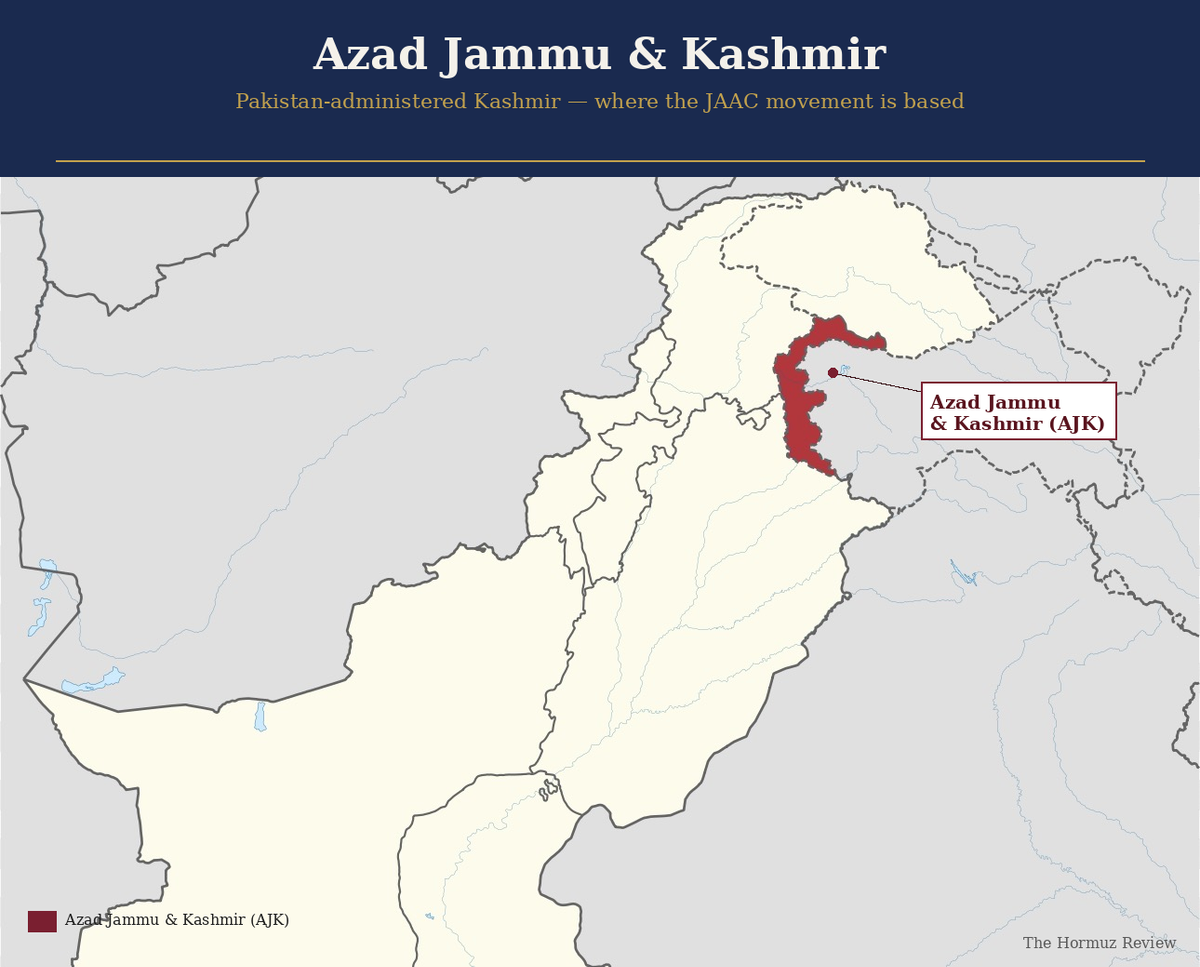
Most political movements that endure begin with something small and concrete. In Pakistan-administered Kashmir — officially Azad Jammu and Kashmir, or AJK — the movement now known as the Joint Awami Action Committee began with electricity bills and the price of flour. Three years later, it is the most significant civic mobilization the region has seen in decades.
The JAAC emerged in 2023 as a grassroots coalition — traders, transporters, lawyers, students — rather than a political party. It was built not around a leader but around a shared list of grievances, which is part of why it has proven so durable.
Its charter of nearly forty demands falls into two categories. The first is economic relief: cheaper electricity, priced at the cost of local hydro production, and subsidized flour. Embedded in that demand is a claim about ownership — that a region generating hydropower has a stake in what it produces.
The second category is structural: ending elite privileges, and — the movement's flashpoint — abolishing twelve Assembly seats reserved for Kashmiri refugees who live in mainland Pakistan. JAAC argues only residents should hold these seats. Critics say the seats reflect Kashmir's disputed status and can't be removed without constitutional change — a position an AJK court upheld in 2026.
The pattern since 2023 is consistent: protests erupt, economic demands get met, structural demands stall, and the movement returns — each time larger. In 2024, a march won price cuts. In late 2025, a general strike turned deadly — at least nine killed, over 200 injured — before a compromise. By 2026, the confrontation sharpened further: authorities banned JAAC under anti-terrorism law, detained members, and further clashes followed. Both sides dispute what happened, and communications restrictions make independent verification difficult.
What makes this significant isn't any single demand. A civic coalition with no party structure has repeatedly brought a region to a standstill — usually a sign of a representation gap, not unusual organizing skill.
That is the real story here: economic grievances, left unresolved, become arguments about power — who owns a region's resources, who sits in its legislature, and who decides. The electricity bill was only ever the beginning.
Muhammad Farrukh Munir is the editor of The Hormuz Review. He writes on political economy, energy, and strategy, and holds a Master of Research from Australia; he previously spent eight years in Saudi Arabia's oil and gas sector.