When the State Sells: Privatization and the Question of Who Buys

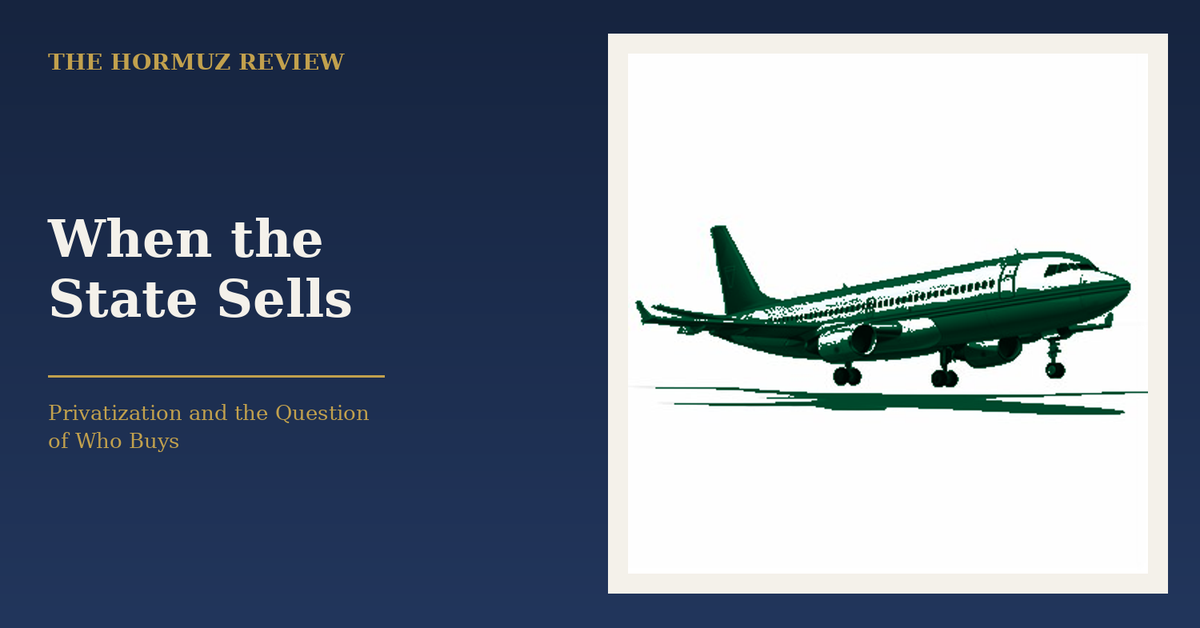
What Pakistan's PIA sale reveals about the limits of divestment in a concentrated economy
Privatization is supposed to answer a simple question: how does a state get out of a business it cannot afford to run? For a chronically loss-making enterprise draining public money year after year, selling to private owners who can run it efficiently is not a scandal — it is often the responsible choice. The recent sale of a majority stake in Pakistan International Airlines belongs, at first glance, to that familiar and defensible story. PIA had become a byword for mismanagement, unpayable debt, and grounded aircraft; successive governments promised reform and none delivered. That the state finally divested is, in itself, not the problem worth examining.
The more interesting question is not whether the state sold, but what a sale like this actually achieves — and here the case opens onto a larger issue in Pakistan's political economy that deserves calm, structural analysis rather than either applause or alarm.
The textbook purpose of privatization is twofold: to relieve the treasury of a loss-making burden, and to move an asset from state control into a genuinely competitive private market, where efficiency is disciplined by competition. The first goal is straightforward and, in the PIA case, largely met. The second is where the analysis gets more complicated — because the value of privatization depends heavily on the structure of the market the asset moves into. Selling a state enterprise into a broad, competitive private sector is one thing. Selling it into an economy where a handful of large, interconnected conglomerates dominate multiple sectors is another. In the latter case, the asset changes hands, but the concentration of economic power may not meaningfully decrease — it may simply be rearranged.
Pakistan's economy has long featured a small number of very large commercial groups whose reach spans finance, energy, cement, food, fertilizer, and infrastructure. Some of these groups are linked, through foundations and welfare arms, to state and institutional structures. This is well documented and not, in itself, a hidden fact. The relevant analytical point is this: when the state divests assets into an economy with high concentration, privatization can produce a paradox. The asset leaves state ownership — satisfying the fiscal goal — without necessarily entering the open, competitive market that justifies privatization in the first place. Ownership becomes more concentrated in private hands that already hold significant economic weight.
The terms of such sales sharpen the question further. To make a bankrupt enterprise attractive, governments often attach concessions — in this case, reported long-term tax exemptions written into the sale agreement and cleared with international lenders. The government's rationale is not unreasonable: a distressed asset cannot be sold without incentives. But when a parliamentary committee itself flags such concessions as potentially anti-competitive — a long tax holiday granted to one market participant and not its rivals — that is not obstruction. That is legislative oversight functioning as intended, and it points to a genuine tension: the concessions that make a sale possible may also distort the very market the sale was meant to open up.
Set the fiscal relief, the market structure, and the sale terms side by side, and a broader pattern in Pakistan's economy comes into view — one that extends well beyond a single airline. For years, discussion of institutional influence in the economy focused on management: who is appointed to head state bodies, regulators, and authorities. The more consequential frontier may be ownership and contracting — who acquires assets when the state divests, and who secures large public contracts when the state builds. Recent months have seen not only the PIA sale but large infrastructure and resource agreements awarded outside fully competitive processes. Across different sectors, a similar set of well-positioned actors recurs. No conspiracy needs to be assumed to notice this; it is visible in the public record, and it reflects the underlying concentration of the economy rather than any single decision.
This is the structural heart of the matter. Privatization is often presented as a choice between an inefficient state and an efficient market. But in a concentrated economy, there is a third possibility that the standard framing misses: the transfer of an asset from the state to a small circle of dominant private actors, which relieves the fiscal burden without delivering the competitive dynamism that is privatization's real justification. Efficiency may improve — that is a genuine possible gain, and it should be acknowledged. But efficiency is not the only public value at stake. Competition, market openness, and the broad distribution of economic opportunity matter too, and they are precisely the values that concentrated divestment can leave unaddressed.
None of this argues against privatization as such. A state has no business indefinitely subsidizing enterprises it cannot run. The argument is narrower and, I think, more useful: that the outcome of privatization should be judged not only by whether the treasury stops bleeding, but by whether the asset genuinely enters a competitive market — and that in an economy as concentrated as Pakistan's, this second test is the harder one to pass, and the one most worth watching.
The quiet way economic structure shifts in many countries is not through dramatic events but through signing ceremonies, board appointments, and clauses in finance bills that few people read closely. That is why this kind of transaction deserves careful, dispassionate scrutiny — not as accusation, but as the ordinary work of understanding who ends up holding a country's productive assets, and what that means for the kind of economy it becomes. Privatization changes who owns things. In a concentrated economy, the question of who owns things is never a small one.
Muhammad Farrukh Munir is the editor of The Hormuz Review. He writes on political economy, energy, and strategy, and holds a Master of Research from Australia; he previously spent eight years in Saudi Arabia's oil and gas sector.